The code on the display, explained plainly.
Your washer, dryer, or dishwasher is showing a code instead of running. This library translates it: what the code means, what usually causes it — in the order worth checking — the safe checks you can do yourself, and the clear line where you stop and call a professional.
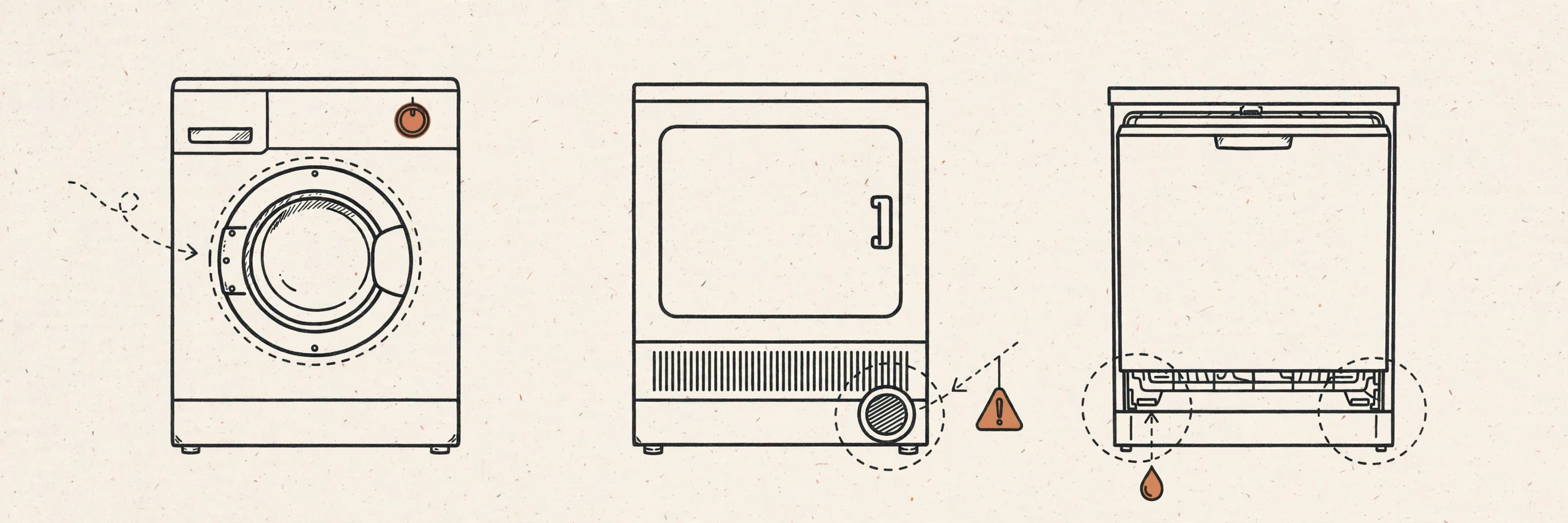
- 7 guides in this first batch
- 5 brands covered
- 3 appliance types
- 0 tools needed to start
Look up your code
Type the code exactly as it appears on the display — or search by brand or appliance. Codes that look different are often the same fault: a Samsung 4C, 4E, and nF are one problem wearing three labels.
Showing all 7 guides in the first batch.
The first batch
Five brands, seven of the most-searched codes — each one a full guide.
The washer is not filling with water the way it should.
Easy — no partsAbout 20 minutesOEOE is a drain error: the washer tried to empty the tub and the water level didn't fall fast enough.
Easy — no partsAbout 15 minutesLCLC means the leak sensor in the base of the dishwasher has detected moisture.
Moderate — patience30 min + drying timed95LG's Flow Sense system measures how freely air moves through the exhaust.
Moderate — vent work45–90 minutesF8 E1F8 E1 is Whirlpool's 'long fill' fault: the washer opened its inlet valve and waited, but the tub didn't reach the expected water level in the allowed time.
Easy — no partsAbout 25 minutes5d / SudThe display is trying to say 'Sud' — excess suds.
Easy — no partsOne cleaning cycleE15Water has collected in the sealed base pan under the dishwasher and lifted the safety float.
Moderate — heavy lifting45 minutesHow every guide is built
One formula, followed the same way on every page.
What it means
The code translated into plain English — what the machine detected, not just what the manual calls it.
Causes, in order
The likely causes ranked most-common first, so you check the free, likely things before the rare, expensive ones.
Safe checks
Step-by-step checks a homeowner can do with the power off and the water shut off. Nothing that opens a sealed system.
Where to stop
Every guide ends with a hard line: the point where the fix stops being a home check and becomes a professional’s job.
Before you touch anything
These rules apply to every guide on this site, no exceptions:
- Power off first. Unplug the machine, or switch off its breaker, before any check that involves reaching inside, moving hoses, or opening a filter.
- Water off before hoses. Close the supply taps before disconnecting any inlet or drain hose — and have a towel and a shallow pan ready. There is always more water in the machine than you expect.
- Never bypass a safety device. No guide here will ever tell you to defeat a leak sensor, a door lock, a thermal fuse, or a float switch. If a “fix” requires it, it isn’t a fix.
- Gas lines are not a home check. On a gas dryer or stove, anything past the lint filter and the vent is a licensed gas fitter’s work.
- Smell gas? Stop. Leave the house, don’t touch switches, and call your gas utility or 911 from outside.
Browse by brand
Same code, different label — start with the name on your machine.